The Basics of Buddhism in the USA
If you’ve ever wondered what Buddhism actually teaches, or you’re searching for how to become a Buddhist in the USA, this is meant to be a starting point, not a deep dive. Buddhism has been around for roughly 2,500 years and has more followers in the U.S. every year, but a lot of introductions to Buddhism get bogged down in vocabulary fast. Here’s the short version, plus the practical steps people actually take.
Who Was the Buddha, Really?
The short answer: a man, not a god. Siddhartha Gautama was born into a wealthy family in what’s now Nepal, and by most accounts had a comfortable, sheltered upbringing. At some point he left that life behind, troubled by the simple fact that everyone suffers eventually, gets sick, grows old, loses people, dies, and set out to figure out why, and whether anything could be done about it.
After years of searching (and some serious trial and error with extreme practices that didn’t work), he sat down and meditated until he had what’s described as a complete awakening to the nature of suffering and how to be free of it. That’s where the title “Buddha” comes from, it just means “the one who woke up.” He spent the next four decades or so teaching what he’d realized, on foot, to anyone willing to listen.
The Basic Ideas
You don’t need a philosophy degree for this part. Most of Buddhism comes back to a small handful of ideas.
Suffering is part of life, and it has a cause. The Buddha’s first teaching is usually summarized as the Four Noble Truths: life involves suffering (not just tragedy, but the everyday friction of things not going how we want), that suffering comes from craving and clinging, that it’s possible to be free of it, and that there’s an actual path to get there. It’s less pessimistic than it sounds; it’s more of a diagnosis than a complaint.
There’s a practical path, not just a belief system. That path is often called the Eightfold Path, and it covers how you think, speak, and act. People usually group it into three buckets: wisdom (seeing clearly), ethics (living honestly and kindly), and mental discipline (meditation and focus). It’s not really a step-by-step checklist so much as several things you work on at once.
Karma isn’t fate, it’s cause and effect. A lot of people picture karma as cosmic punishment, but in Buddhism it’s closer to “actions have consequences.” Act with greed or cruelty, and that tends to ripple outward and create more suffering. Act with kindness, and that tends to do the opposite.
Meditation is where most people actually start. Long before anyone studies the philosophy, plenty of people in the U.S. show up to Buddhism through meditation: sitting quietly, watching the breath, noticing thoughts without getting swept up in them. It’s often the most direct way to understand what the teachings are pointing at.
So… Which Buddhism?
Here’s something that surprises a lot of newcomers: Buddhism isn’t one unified religion with a single set of rules. Over centuries it split into different traditions, each shaped by the culture it took root in.
Theravada is the older, more conservative branch, practiced widely in Thailand, Myanmar, and Sri Lanka, and it sticks closely to the earliest recorded teachings. Mahayana, found across China, Korea, and Japan, broadens the focus toward compassion for all beings, not just personal awakening. Vajrayana, often called Tibetan Buddhism, is known for its rituals, chanting, and lineage of teachers, and became more visible in the West through figures like the Dalai Lama. And then there’s Zen, technically a school within Mahayana, which strips things down to simplicity and direct experience through sitting meditation; it’s probably the most recognizable form of Buddhism in American pop culture.
None of these is the “right” one. Most people who stick with Buddhism end up gravitating toward whichever tradition’s style actually fits how they think and practice.
How to Become a Buddhist: The Actual Steps
This is where Buddhism looks pretty different from religions with a clear membership process. There’s no single governing body, no card you carry, no one moment that applies to everyone. But if you’re looking for how to become a Buddhist in the USA specifically, there’s a general path most people end up following.
1. Start by learning. Read a book or two, listen to some talks, maybe visit a nearby temple if you’re curious. Nobody expects you to understand everything right away, and there’s genuinely no rush here.
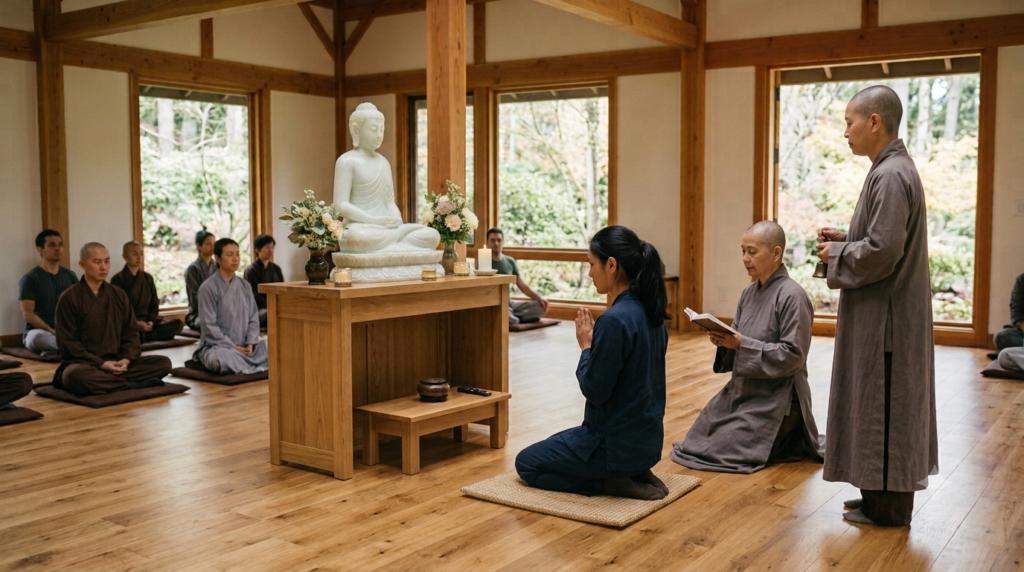
2. Try meditating. Most temples and meditation centers in the U.S. run beginner sessions that are open to the public, often free. This is usually the part where Buddhism stops being abstract and starts being something you actually experience.
3. Find a sangha. That’s the term for a community of practitioners. Showing up regularly, whether at a temple, a small meditation group, or somewhere online, matters more than people expect. It’s also how you end up with access to teachers who can actually answer your questions. Organizations like Plum Village and Fo Guang Shan run retreats and beginner-friendly classes across the country, and they’re a low-pressure way to meet a sangha without committing to anything.
4. Consider taking refuge. When someone wants to formally commit, most Buddhist traditions offer a ceremony called Taking Refuge in the Three Jewels: the Buddha (the teacher), the Dharma (the teachings), and the Sangha (the community). In a lot of schools, this ceremony is considered the actual moment someone becomes Buddhist. How big a deal it is depends on who you ask, some communities treat it as a real turning point, others see it as more of an ongoing commitment than a one-time event. Either way, it’s usually a simple, low-pressure ceremony, and plenty of people spend years exploring before they ever take this step, if they take it at all.
5. Volunteer. This is actually one of the better ways to start. You get to engage with the Buddhist community directly, see how it actually operates, not just how it’s presented in a curated talk, and do something good in the process.
6. Keep practicing. This is really the heart of it. Becoming Buddhist isn’t a finish line, it’s an ongoing way of living: paying attention, acting with more kindness, sitting with discomfort instead of running from it. Some people attend services or retreats regularly; others practice mostly on their own.
A Few Last Things
You don’t have to give up other beliefs to explore Buddhism. Plenty of people fold meditation or mindfulness into a faith they already practice, or into no faith at all. There’s also no “correct” entry point: picking up a book, trying a guided meditation app, or just walking into a temple are all completely legitimate ways to start. And if you do visit somewhere in person, don’t worry about getting the customs wrong; most communities are used to newcomers and welcome questions.
At the end of the day, Buddhism is less about what you believe and more about how you live. If you’re still figuring out how to become a Buddhist, the honest answer is that you probably already have: you just keep practicing, keep paying attention, and let the rest sort itself out.
Frequently Asked Questions
"What are the requirements to become a Buddhist?"
Most sources agree there’s no fixed checklist, but the common ground is: taking refuge in the Triple Gem — reciting the refuge verse before a monastic — is the typical formal marker, often paired with committing to one or more of the five precepts as the ethical foundation.
"Can anyone become a Buddhist?"
“Can anyone become a Buddhist?”
Yes — there’s no birthright requirement; a person can come from any race, country, economic background, or gender and still take up the practice.
"How do you convert to Buddhism?" / "How does one convert to Buddhism?"
“How do you convert to Buddhism?” / “How does one convert to Buddhism?”
This shows up almost verbatim across Quora threads. It’s a question people ask alongside “what conditions need to be fulfilled to be called a Buddhist.” The practical answer across sources is the same: study, meditate, connect with a sangha, then optionally formalize it through refuge.
"Do you have to give up meat, possessions, or your lifestyle to become a Buddhist?"
No. Lay Buddhists don’t need to wear special clothing, change their diet, or give up possessions or a social life — Diamond Way Buddhists, for example, are laypeople with regular jobs and families who fold Buddhist practice into ordinary life.
"Is meditation the same as being Buddhist?"
No — this is a distinction beginner guides keep having to make. Many people assume meditation is essentially what defines a Buddhist, but becoming Buddhist actually involves a broader system of values, practices, and beliefs beyond mindfulness meditation alone.
"What is the ceremony called when you become a Buddhist?"
It’s called the refuge ceremony — taking refuge in the three jewels: the Buddha, the dharma, and the sangha. This is distinct from ordination as a monk or nun, which is a separate, much heavier lifelong commitment.